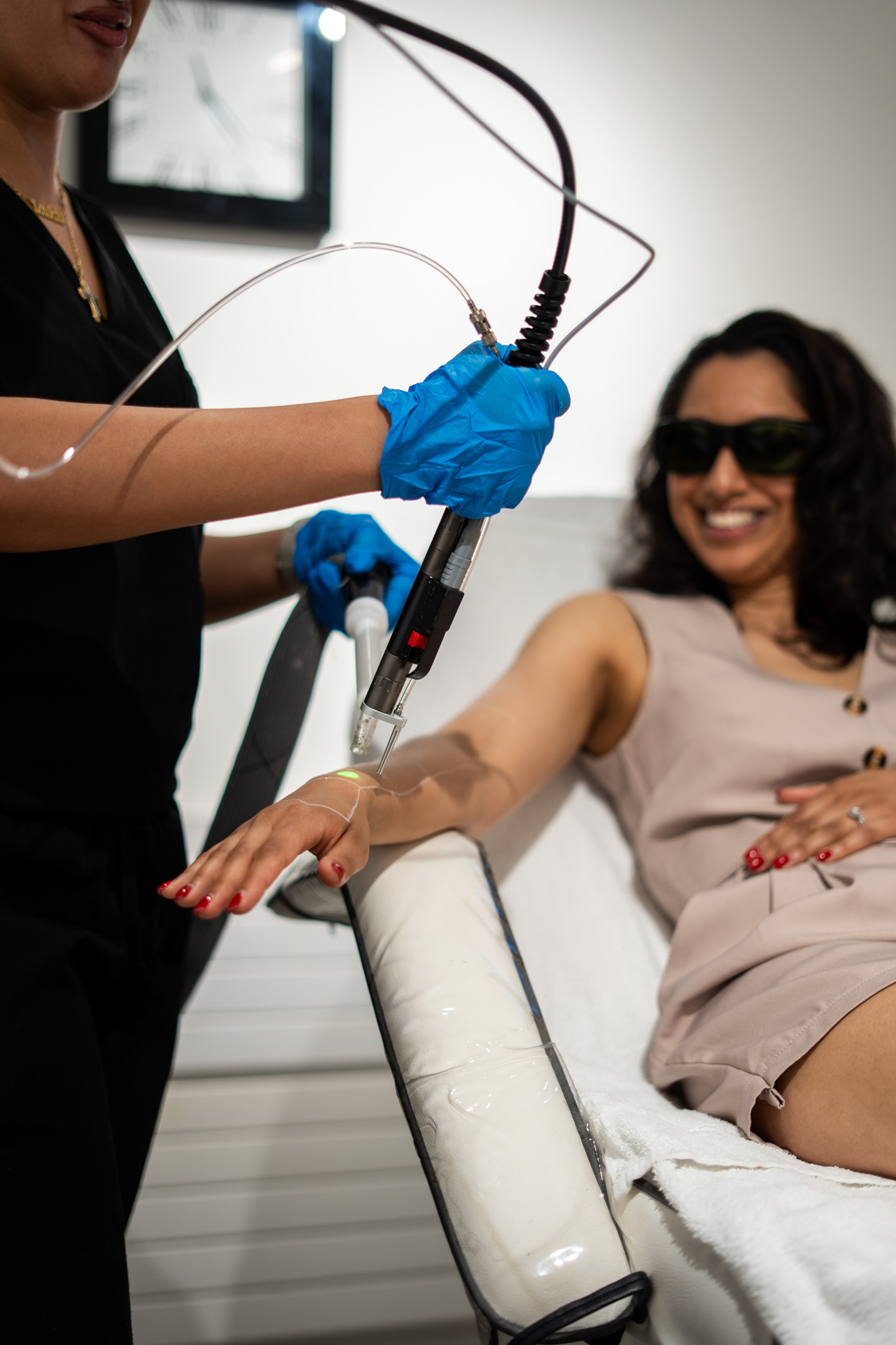

If you’ve been looking into permanent hair reduction, you’ve almost certainly come across two terms: Laser Hair Removal and Intense Pulsed Light (IPL). They are often advertised as if they do the exact same thing, and high-street clinics often use the words interchangeably.
The truth? They are fundamentally different technologies.
While both use light energy to target hair, how they deliver that energy – and the results they produce – couldn’t be more different. Choosing between them usually comes down to whether you want a permanent reduction using clinical equipment or a temporary thinning using beauty-grade gear.
Here is a straightforward breakdown of what’s actually happening under your skin with both treatments, so you can make an informed choice.
A real medical laser produces a single, focused wavelength of light running in a straight line (known as monochromatic, collimated light).
Because the beam uses just one precise wavelength, all of its energy goes toward a single target: the melanin (pigment) inside the hair root. When the laser fires, the heat travels straight down the hair shaft into the bulb, destroying the follicle’s ability to regrow hair without heating up the surrounding skin.
IPL is not a laser. It uses a high-powered bulb that flashes a broad spectrum of light in multiple directions, much like a household lightbulb.
Because this light contains many different wavelengths scattered at varying depths, only a tiny fraction of the energy actually reaches the hair follicle. The rest of the light energy absorbs into the surrounding skin tissue. This is why IPL carries a higher risk of surface burns, especially on darker skin, while delivering far less heat to the root where it’s actually needed.
| Feature | Medical-Grade Laser | IPL (Intense Pulsed Light) |
| Light Type | Single, direct wavelength | Broad-spectrum, scattered light |
| Energy Target | Direct hit on the hair follicle root | Diffused across skin and hair |
| Skin Safety | Safe for all skin tones (with Nd:YAG) | Higher risk on darker or tanned skin |
| Typical Sessions Needed | 6 to 8 sessions | 10 to 15+ sessions |
| Result Longevity | Long-term, permanent reduction | Hair thinning; regular top-ups required |
| Equipment Class | NHS-standard, clinical platform | General aesthetic/salon equipment |
One of the biggest issues with IPL is safety on darker or tanned skin.
Because IPL broadcasts a wide band of light, the surface pigment in darker skin (Fitzpatrick types IV to VI) absorbs a lot of that scattered heat before it ever gets close to the hair root. This can cause severe skin irritation, hyperpigmentation, or accidental burns.
Medical lasers avoid this by using specific wavelengths matched to your skin tone:
Having access to these two dedicated wavelengths means every skin type can be treated safely at high enough energies to actually destroy the hair follicle.
It’s common to see local salons offering extremely cheap IPL packages. The reason for the price difference comes down to the machinery and training:
While IPL can look like a bargain upfront, most people end up spending more money overall trying to maintain results that a proper laser course would have achieved in far fewer visits.
If you are looking to lighten fine body hair or want an at-home touch-up device to slow down growth slightly, IPL can be an option.
However, if you want permanent hair reduction, have stubborn hair (like PCOS growth or beard shadow), or have a darker skin tone, a medical-grade laser is the only technology that delivers consistent, safe, and lasting results.
Ready to start your journey? Book your complimentary, no-obligation consultation today. Our practitioners will assess your skin, answer your questions, and design a personalized treatment plan tailored specifically to you.